At Westminster
My first visit to America’s most famous dog show.

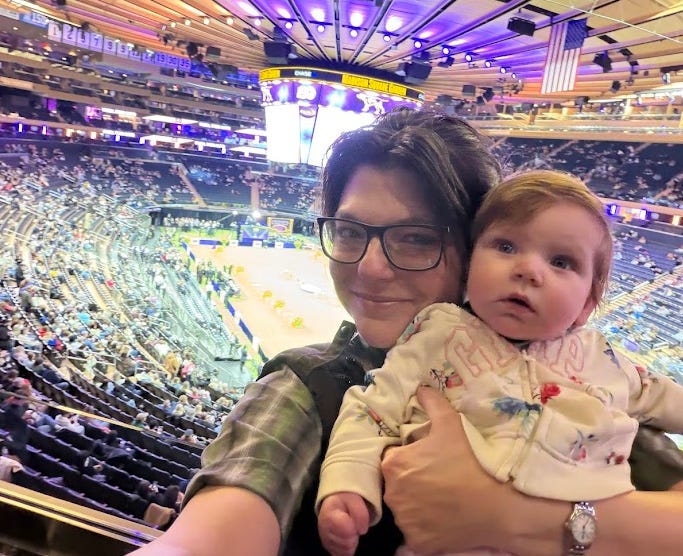
On Tuesday night I went to the Westminster Kennel Club dog show at NYC’s Madison Square Garden. I’d never been to a dog show before. Neither had my six-month-old daughter, Rose.
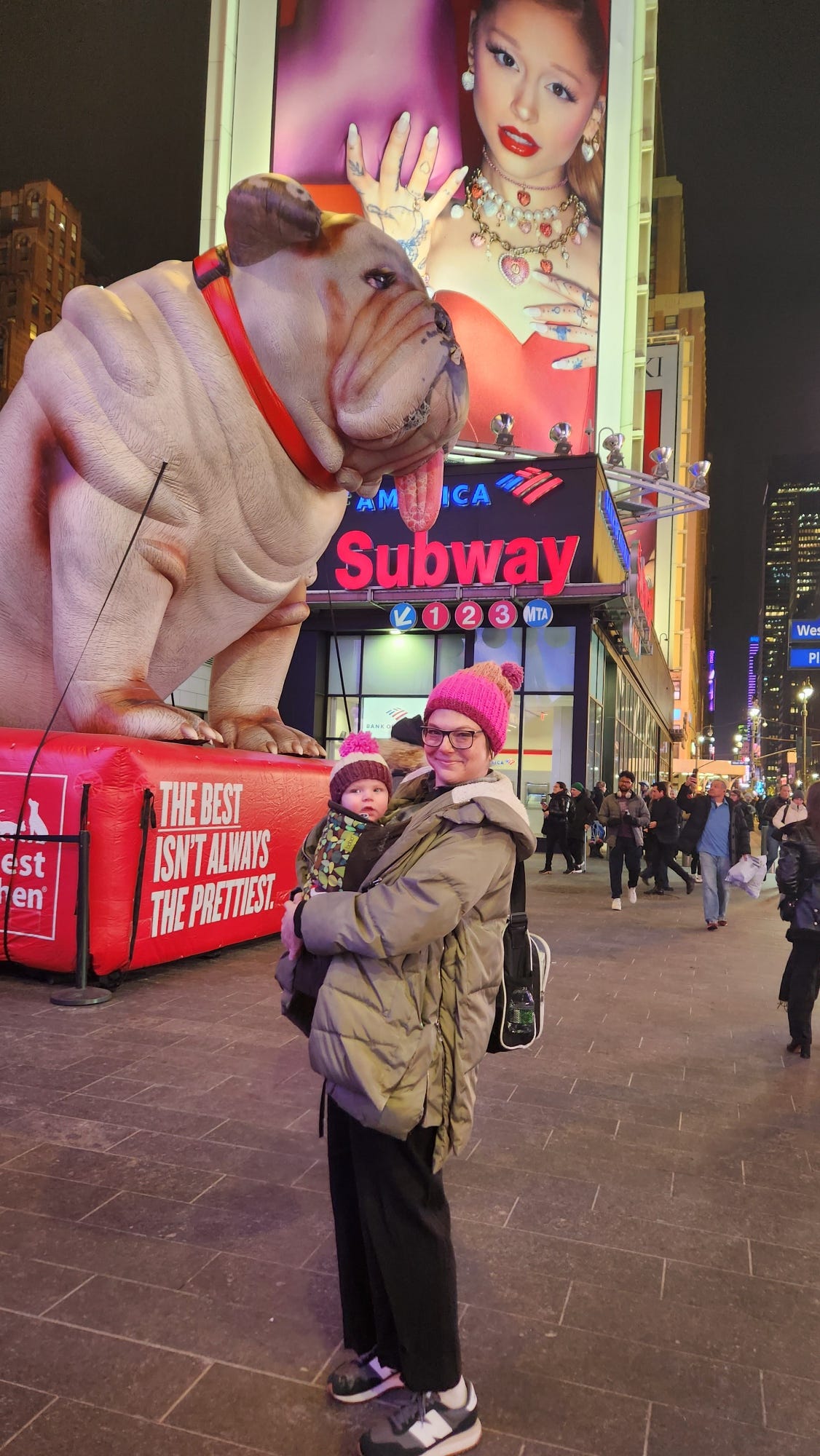
Rose is still too little to be left with a sitter, and my husband was attending a lecture about Aquinas given by a priest visiting from the Vatican— arguably the less baby-friendly event.
My other date for the night was Lili Chin, an illustrator who is well known for her drawings about dog behavior.
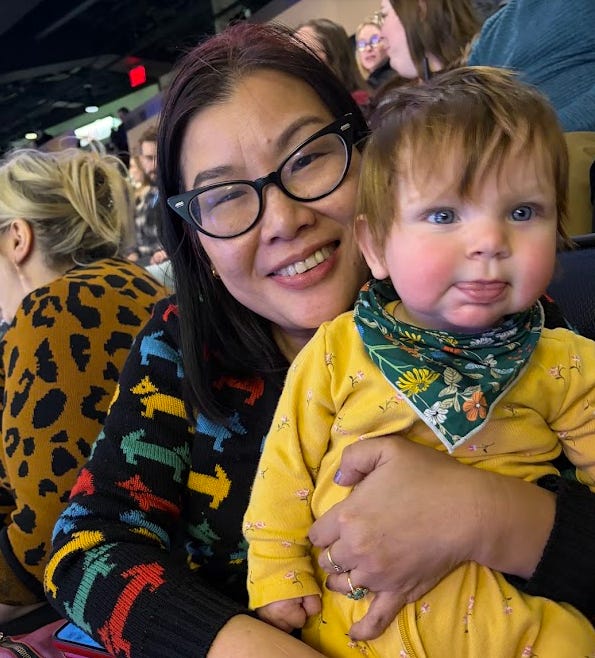
Lili was visiting from LA. She got interested in dog training fifteen or so years ago after her late dog Boogie, a Boston Terrier rescue, bit her landlord. The landlord said either the dog had to go or she had to move. Lili suggested that maybe she could invest in training to solve the problem; he said she could give it a shot.
The first trainer, a Cesar Millan acolyte, put a shock collar on little Boogie and his behavior got worse. Desperate to figure out some other solution, Lili wrote to a trainer who was doing a Q&A column at Dogster.com, and got a response that introduced her to the world of positive reinforcement training.
Much of Lili’s education came from learning how to read Boogie’s body language — recognizing discomfort before it escalated. To help others better understand their dog’s physical vocabulary, she created a free downloadable poster that is as ubiquitous in dog training studios as choking first-aid charts are in restaurants.
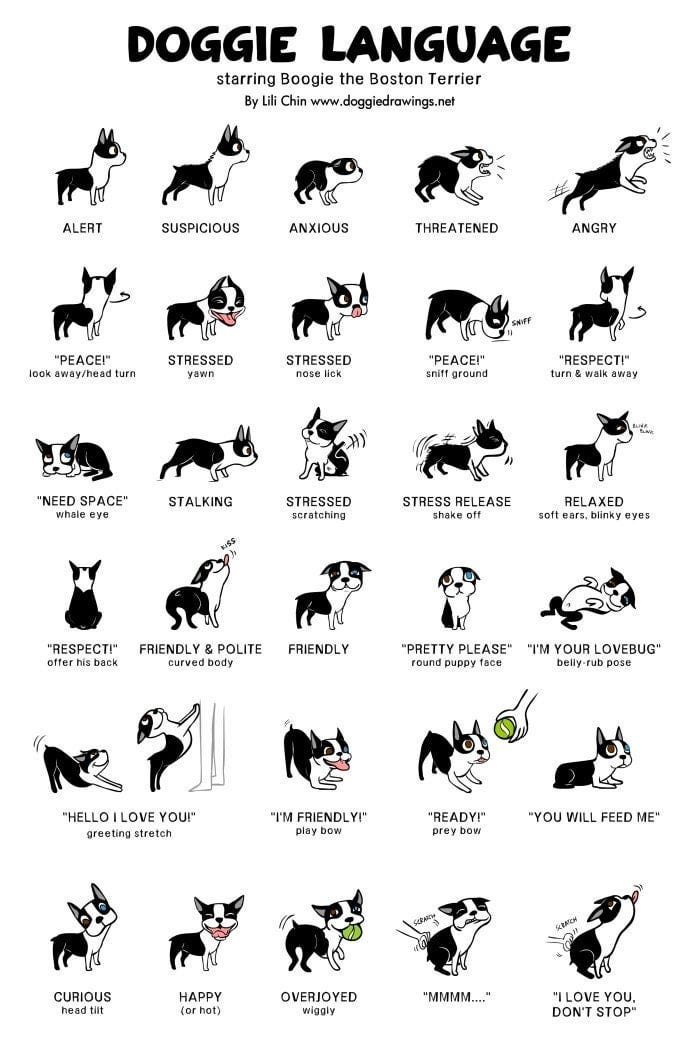
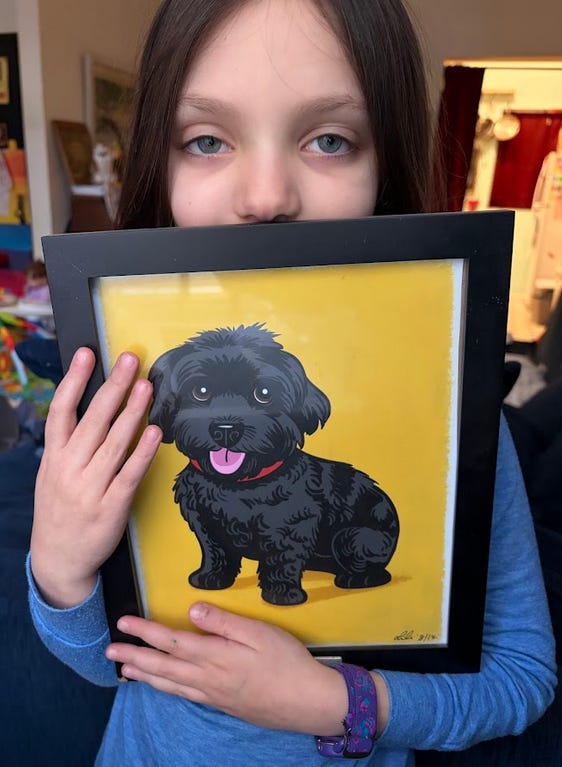
The success of this poster (and others of its kind) would lead to her 2020 book Doggie Language, and later to Dogs of The World. She has illustrated books by many of the best dog trainers out there. She also does commissioned pieces. She once even painted my beloved Amos!
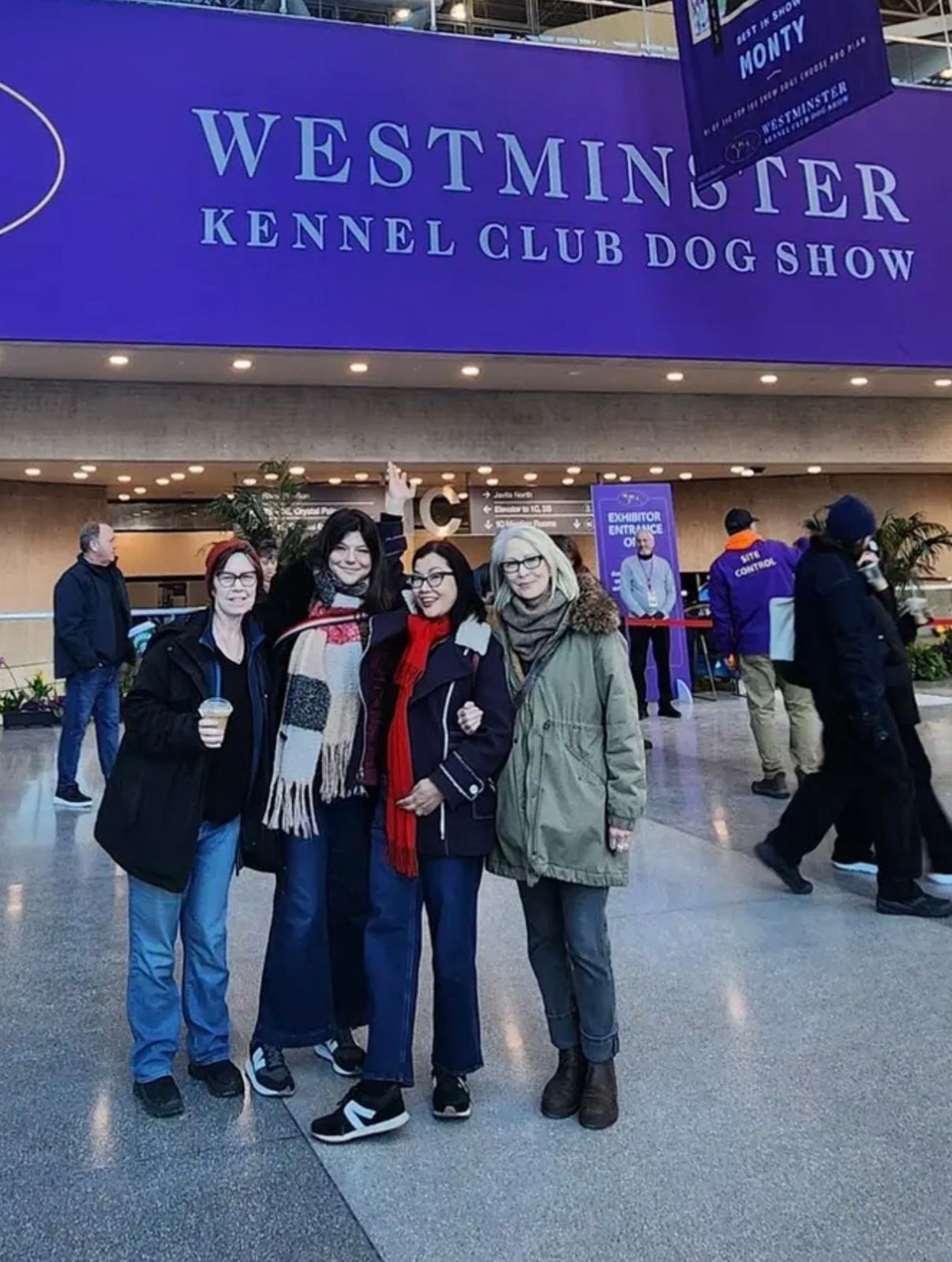
Lili said she was going to be in town and asked if I wanted to go to the show and I said sure, if only because it’d be a chance to hang out with the only professional dog illustrator I have ever met. The day before, at the portion of the show that was held at the Javits Center, Lili’s friend Laura joined us, as did her friend Pilley Bianchi, who is the author of For The Love of Dog, and the human sister of the dog Chaser, the border collie who famously demonstrated her knowledge of over 1000 words. (Her late father was Chaser’s owner, the behavioral psychologist John W. Pilley; Bianchi helped train Chaser).
Pilley left early because she was uncomfortable about all the choke collars dogs were wearing. Show dogs technically don’t wear choke collars. They wear slip leads that are designed to be delicate in order to be visually unobtrusive. I think it’s kind of nice that they’re so thin, but I appreciate her observation as they don’t look particularly comfortable.
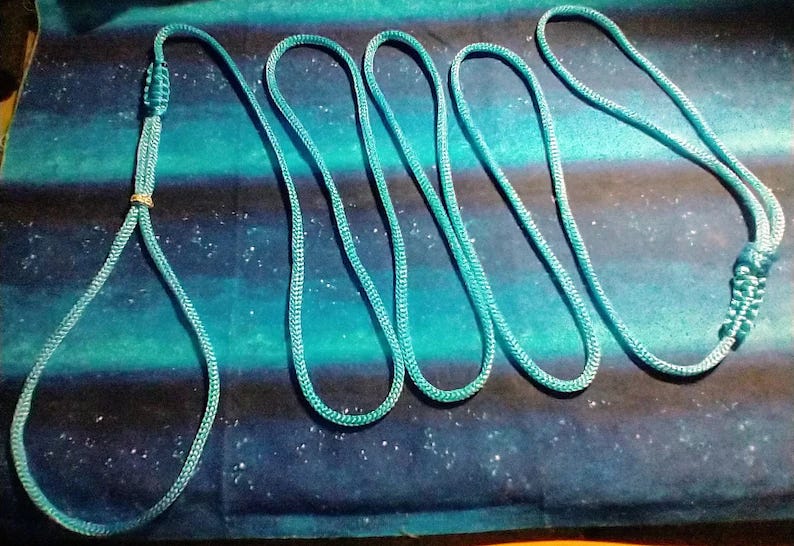
My feelings about this type of leash I guess echoe my feelings about the existence of dog shows in general: mixed.
On one hand, it’s cool that there’s all these people who love dogs enough to build a hobby that involves spending enormous amounts of time with them. And honestly, the dogs at Westminster didn’t strike me as particularly unhappy. To get there, they’ve already won a bunch of shows, so the whole thing must seem old hat to them. At worst, some looked a little bored — not distressed, just the kind of bored I felt as a kid being dragged through Bloomingdale’s while my mom shopped for bras.
I can’t think of any other competitions where the competitors care so little about winning.
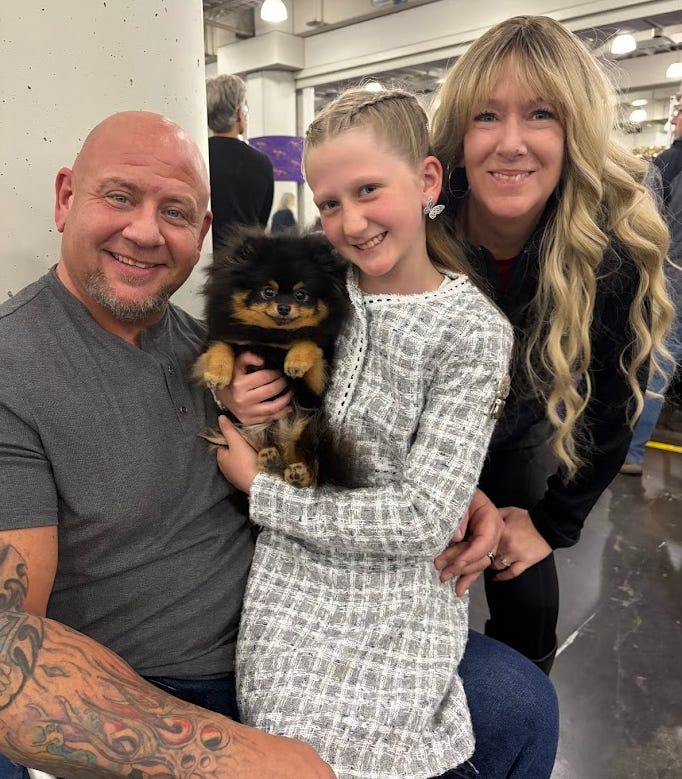
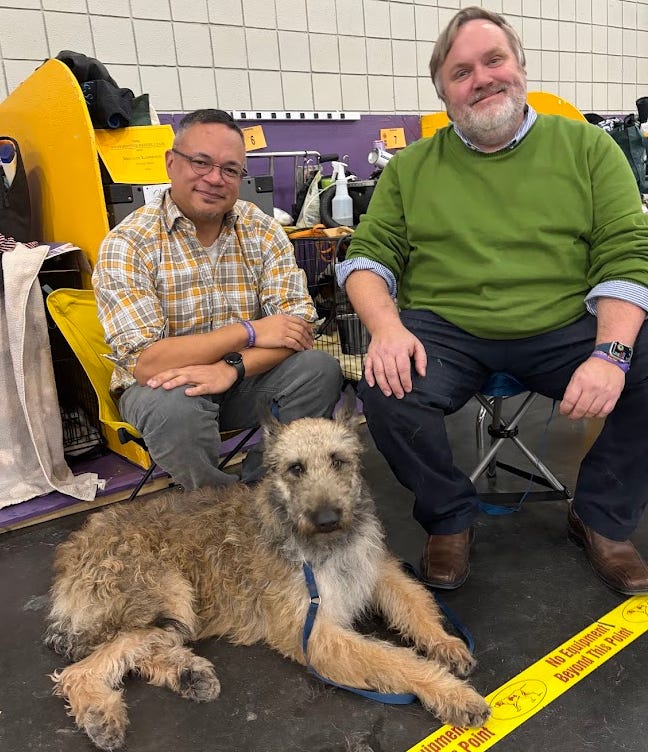
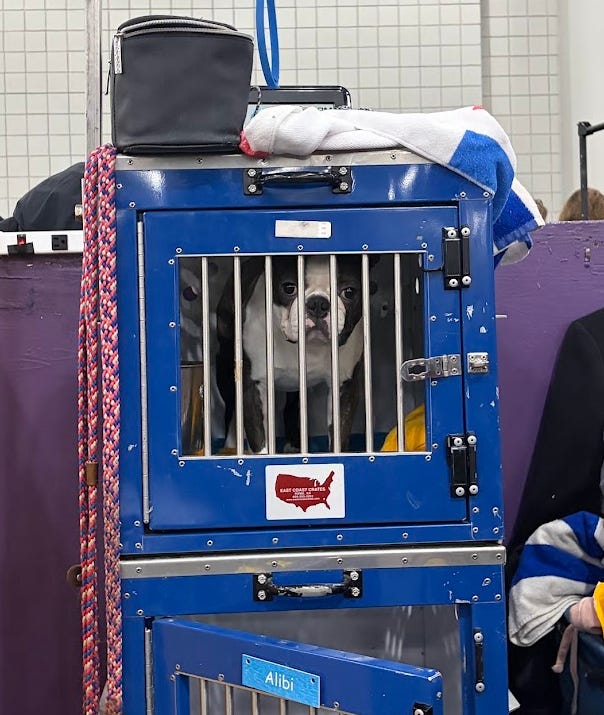
On the other hand… while I am not against breeding dogs, I think breeding for anything other than a dog’s health and behavior seems like a bad idea. I mean, we consider dogs our family, but would you want your cousin to be bred to your grandfather to ensure their progeny has good hair?
Breeders make claims about their breed’s behavior, and these kinds of generalizations promise predictability, but behavior is always shaped as much by environment as inheritance. All that is to say that I prefer to consider the dog in front of me as an individual, rather than something more akin to a plant cutting.
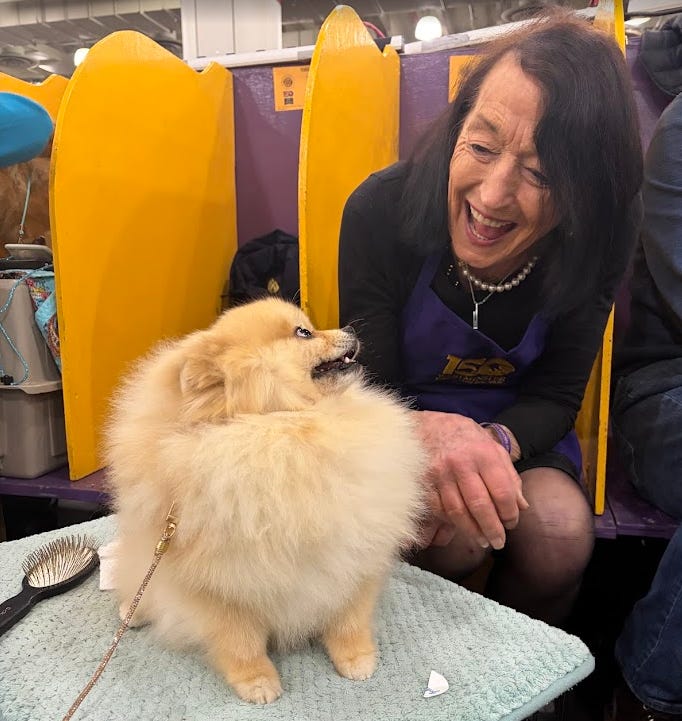
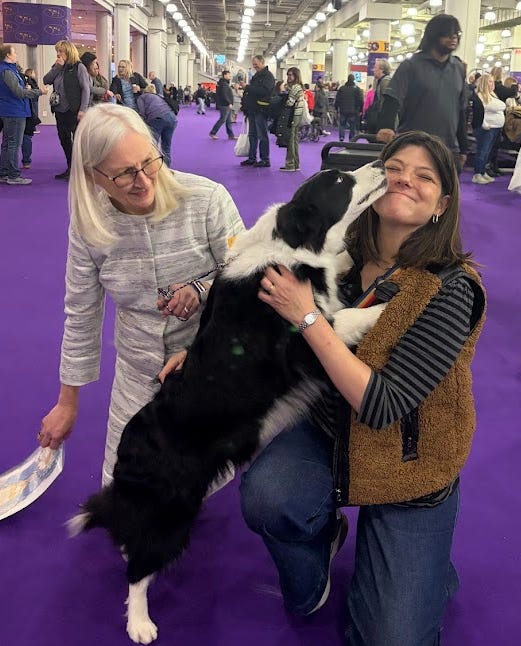
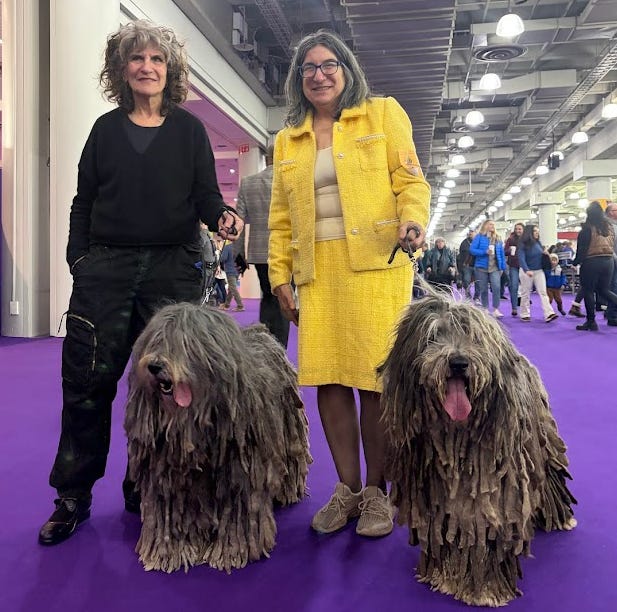
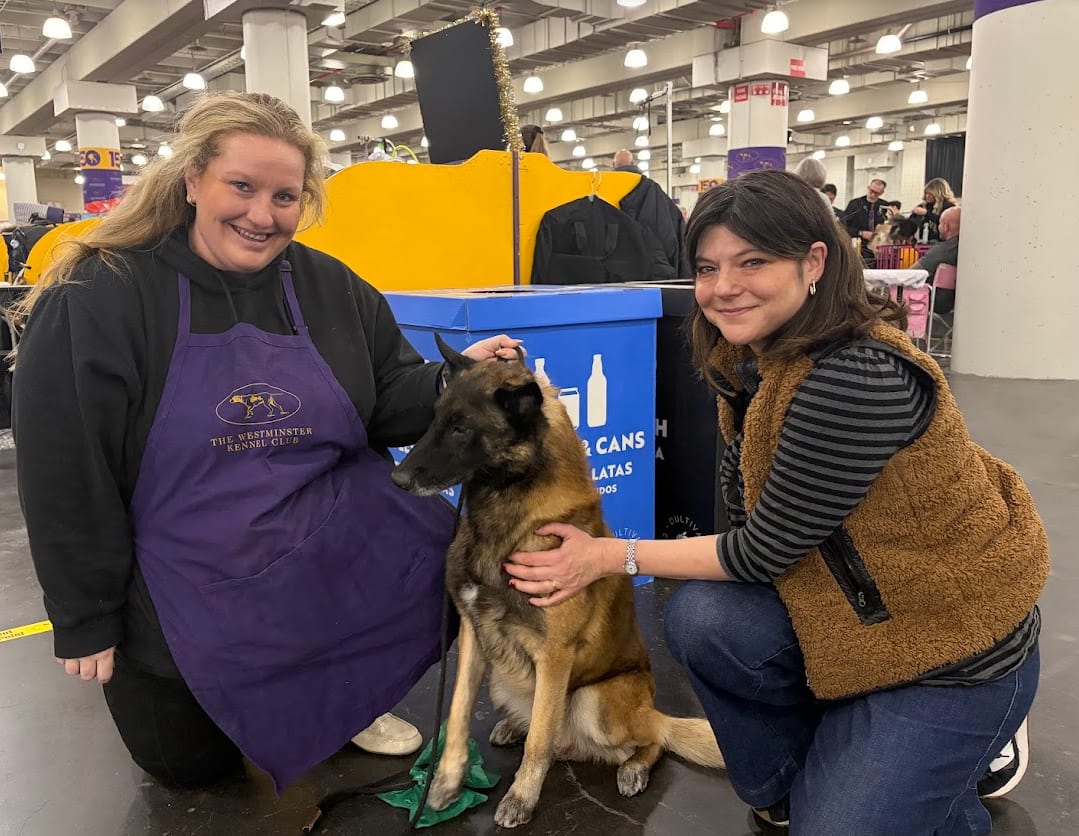
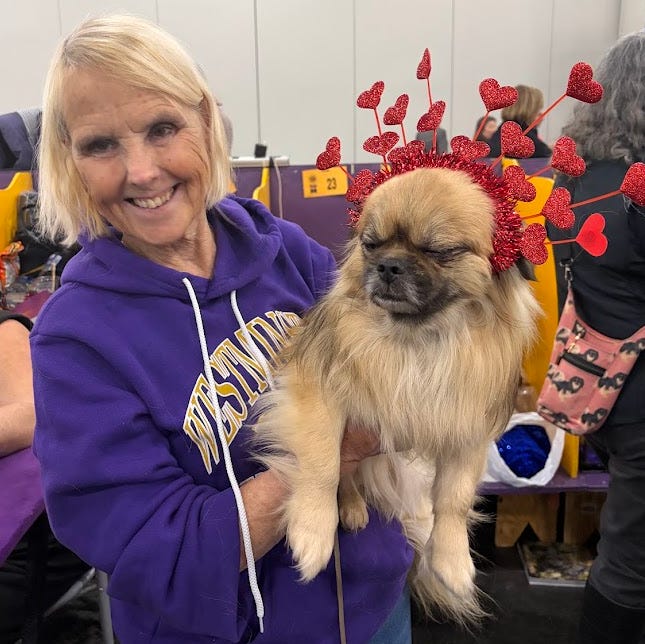
During the show, Lili and I exchanged a look whenever behavioral characteristics were flashed on the screens and attributed to any given breed. The Teddy Roosevelt Terrier is supposed to have a “class clown mentality” The Sloughi is “aloof.” The Petit Basset Griffon Vendéen is “confident, happy, extroverted, independent yet willing to please, never timid nor aggressive.” The idea that anyone could evaluate a dog’s personality traits based on watching them trot around a ring and stand on a table for less than a minute feels to me less like science than theater.
These descriptions are pulled from the American Kennel Club’s “Breed Standard,” If you’re not familiar with dog shows, this is basically how it works: Every dog is being judged by how well they conform to a highly specific description that exists in this document, which usually devotes one or two single-spaced pages to each breed. I don’t know how a judge could possibly ascertain if a dog really is, say, “never timid or aggressive.” While behavioral characteristics are professed, there really is no talent portion of this competition (beyond showing that they can prance on leash and stand still on a table — not things just any can do!). It feels, more than anything else, like a beauty competition. As if to drive home this point, at the start of the show, the jumbotrons featured a segment with a enthroned Megan Thee Stallion, donning black opera gloves and a plunging black halter dress, seated on a golden throne with her French bulldog, 4oe, (pronounced like the Vietnamese soup).
“It’s all about glitz, glamour, style and grace and a charm that will steal America’s heart,” she says. The dog lip-licked through the whole thing— a common sign of stress.
(The only other celebrity to get Jumboscreen time was the recently deceased Catherine O’Hara, a medley of her work was aired just before the Terrier portion of the show — she famously played the owner of a Norwich in the mockumentary Best Of Show).
After the show, I looked up the documents that contain the breed standards (some of which have remained unchanged for more than a century) and the detail in them is something to behold. The Bluetick Coonhound, for instance, has a “slightly domed skull. Total length of head from occiput to end of nose is 9 to 10 inches in males and 8 to 9 inches in females, foreface should be 3 to 4½ inches.”
At these shows, the breeder is the unseen hero (or antihero, depending on your point of view), as they’re the ones figuring out how to create a dog with the right size foreface. But the people who get more visibility are the handlers. The day before the Madison Square Garden event, where the Best in Breed and Best in Show judgings were held, I went to the Javits Center, where the breeds compete against each other in the daytime hours. There, I met a handler named Christa Cook, who is based near St. Louis and is a Westminster veteran — in 2019, she handled the first Schipperke to ever win the Non-Sporting Group. She was there with several dogs, including Jake, a Chinese Crested who ended up with an Award of Merit for the breed (basically a runner up). She told me she is one of about three hundred professional handlers. Owners find her, often through the breeder they bought their dog from, then bring the dog to her for evaluation, and, if she deems them worthy, she brings them to these shows all over the country. She attends nearly 200 shows a year. Here she is, giving me a little rundown of how it all works, and why she things selecting dogs by their looks is a good idea:
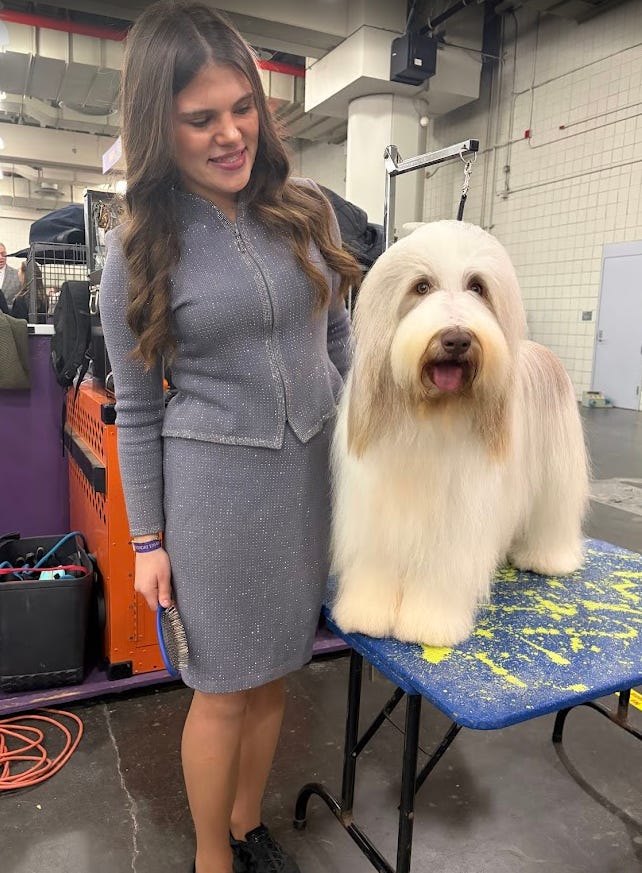
One thing I noticed about handlers is that many of they wear a lot of sparky clothing. One handler about it and she said this was traditional style for winter shows and that most handlers buy these designer two-piece suits from St. Johns, where the price tag hovers around $2000 for a suit.
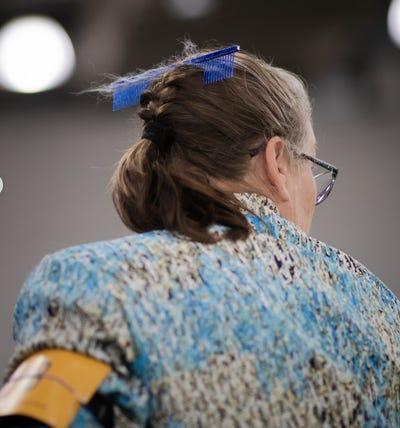
Many of the handlers also accessorize with a color coordinated comb in their hair, I suppose for last minute dog primping. They poke them into the top of their ponytails or braids, parallel to their shoulders. The first person I saw with this do, I thought they must’ve gotten distracted while getting ready. But then I saw another, and another.
In the holding area at the Javits Center, I also met Chris Nelson, who helped advise Lili on Dogs Of The World. Chris got interested in dog breeds when he was in middle school and his parents got him a CD-Rom about dog breeds. It became an obsession. His first visit to Westminster was a high school graduation gift from his family in 2009. Chris announces shows all around the country, and aspires to one day announce at Westminster. I asked him to pick a breed at random and pretend he was announcing them at Westminster.
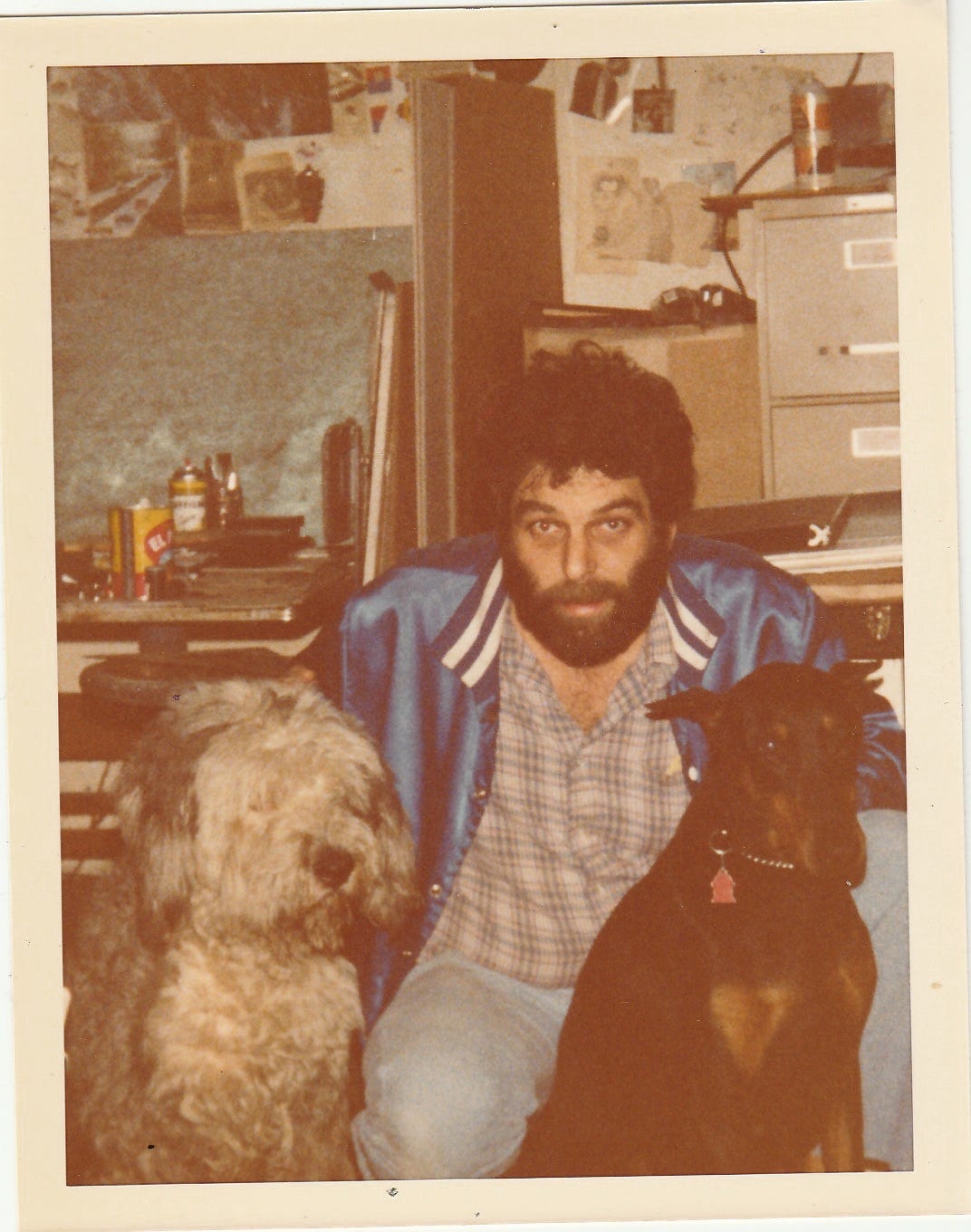
This was the moment where I found myself rooting for the Doberman. Also: My dad had a Doberman when I was growing up. He actually got her from his neighbor in his building, who was breeding Dobermans as protection dogs. This was on Crosby Street in Soho. It’s hard to imagine someone breeding Doberman guard dogs in downtown Manhattan, but the seventies were just that wild, I guess.
I was also partial to the Old English Sheepdog, partially because, well… look at them!
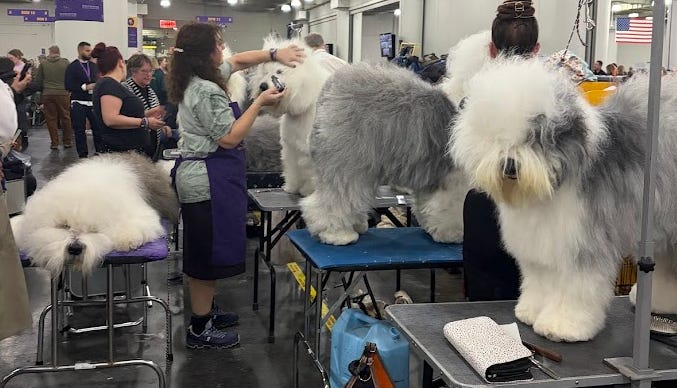
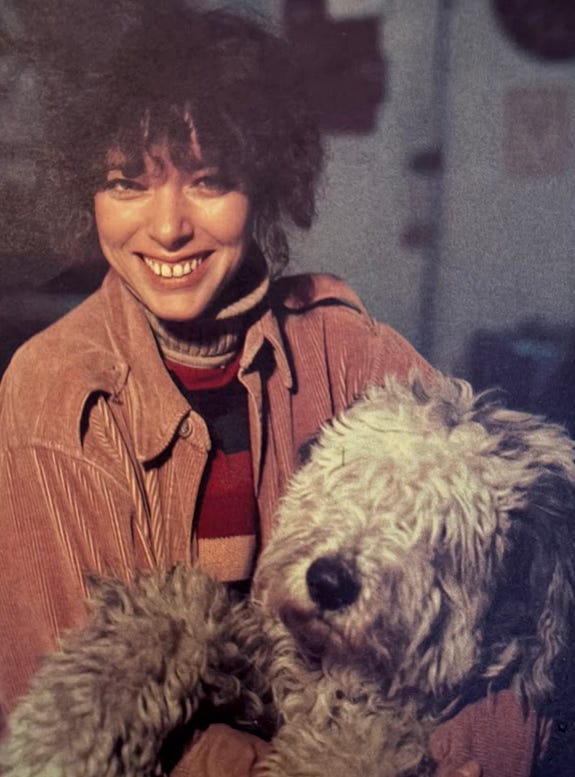
And partially because my mom had one when I was born.
When my mom met my dad, whose name was Bob, she was pretty shocked to learn that his Doberman was named Margot: Her parents’ names were Bob and Margot!
So, I went into Madison Square Garden rooting for the Doberman. But then, soon after the show started, I admit my eyes sort of glazed over. We were probably sixty feet above the action, and surrounded by more TVs than you find at a sports bar. It reminded me of the last time I went to a baseball game: There was a lot of green to look at. Except instead of men in tight pants catching balls on a green expanse, it was mostly women in sequins trotting around with breeds of dogs I’d never heard of. There was no announcer like there is when you watch on TV. So, it all seemed like a bit of a blur. When Rosie (who was strapped to me) and I went to go drop $23 on a to-go burger, I was pretty sure I wouldn’t regret missing something.
I was back in my seat when Penny the Doberman won Best in the Working Group. And I was… hardly more excited about this turn of events than she was.
I left a bit before the Best in Show competition started. That’s where the winner of each group competes against each other, with the judge figuring out which champion from each group is most exactly like its Breed Standard. It was past ten, and, back home, my older daughters had requisitioned my husband’s phone — the dog show went longer than the Aquinas lecture. My four year old texted that she’d decided she wants a gumball machine for her birthday (which is in June). My seven year old said she hoped I was having fun but that she missed me “desperately.” I felt the strong urge to go home and…measure their forefaces.
They were asleep by the time I got back. Before I turned in myself, I checked the news on my phone and… saw that Penny the Doberman won!
This meant, in the morning, I’d have a good reason to show them a picture of their grandpa and Margot.