


I recently overheard someone at the dog park saying that they started to reward their dog when they bark at the door and that this has helped the dog stop barking at the door. How can this be? Wouldn’t rewarding the dog for barking produce… more barking? — Hella P., Davis, CA

Positive reinforcement training gets flattened into “give the dog treats,” and positive reinforcement trainers get dismissed as “cookie pushers.” (For the record, if you’re in my vicinity, cookie pushing is welcome —especially if they’re from Levain.) But that caricature strips away the nuance and structure that make positive reinforcment, as a training technology, work.
For many dog owners, barking is a nuisance. For many dogs, it’s a job.
Over thousands of years, dogs evolved to bark — likely because the barkiest ones were especially useful to humans before alarm systems existed. Those dogs got more resources, lived closer to humans, and passed on their genes.
Now, of course, we put dogs in tight quarters where there are lots of stimuli that may or may not be dangerous, and when they try to warn us or bark to make the possibly dangerous things go away, we punish them. It really is too easy to be a dick to your dog!
Your fellow dog park-goer might have been referring to a protocol that has been made popular by my friend Kiki Yablon, often called the Thank You For Barking Protocol. The general idea of this method is to give a clear signal, such as saying “Thank You,” after your dog barks once at a predictable trigger.
The “Thank You” is, essentially, a cue that indicates to your dog that a reward is about to come, from you.
Sounds straightforward, but to make it work, it needs to be approached thoughtfully. For instance, you have to be super consistent, which might mean putting in place some careful environmental management to make sure the triggers that lead to barking won’t be perceived unless you’re there with treats (for example: if your dog barks in your yard when the neighbor’s dog is in the nextdoor yard, don’t let your dog into the yard unless you’re there, too).
Ideally, you are working up to rewarding your dog in the moment between when they perceive the trigger, and they bark. The dog is rewarded for barking once and learns that barking once is all that needs to be done (having treats in the mouth after that one bark also makes it harder to keep barking). Like humans, they like doing as little work as possible for as much pay as possible. If they can conserve time and caloric energy by barking once instead of a million times, they will.
What I love about Kiki’s protocol is that it honors the dog’s evolutionary job — “alert the humans!” — while shaping it into something compatible with modern living. We’re not suppressing the behavior; we’re channeling it.
This approach keeps us from having to rely on punishment or negative reinforcement. Using aversives to stop barking can be problematic for many reasons. For instance, you might think you’re punishing your dog for barking at the squirrel, but he might think he’s being punished for looking at the neighbor’s kid, and that could lead him to become aggressive towards the kid, for example. Punishment also can lose its power little by little—a dog can become inured to it, which means you have to yell at them louder in order to keep them from barking, or make a shock collar zap them at a stronger level.
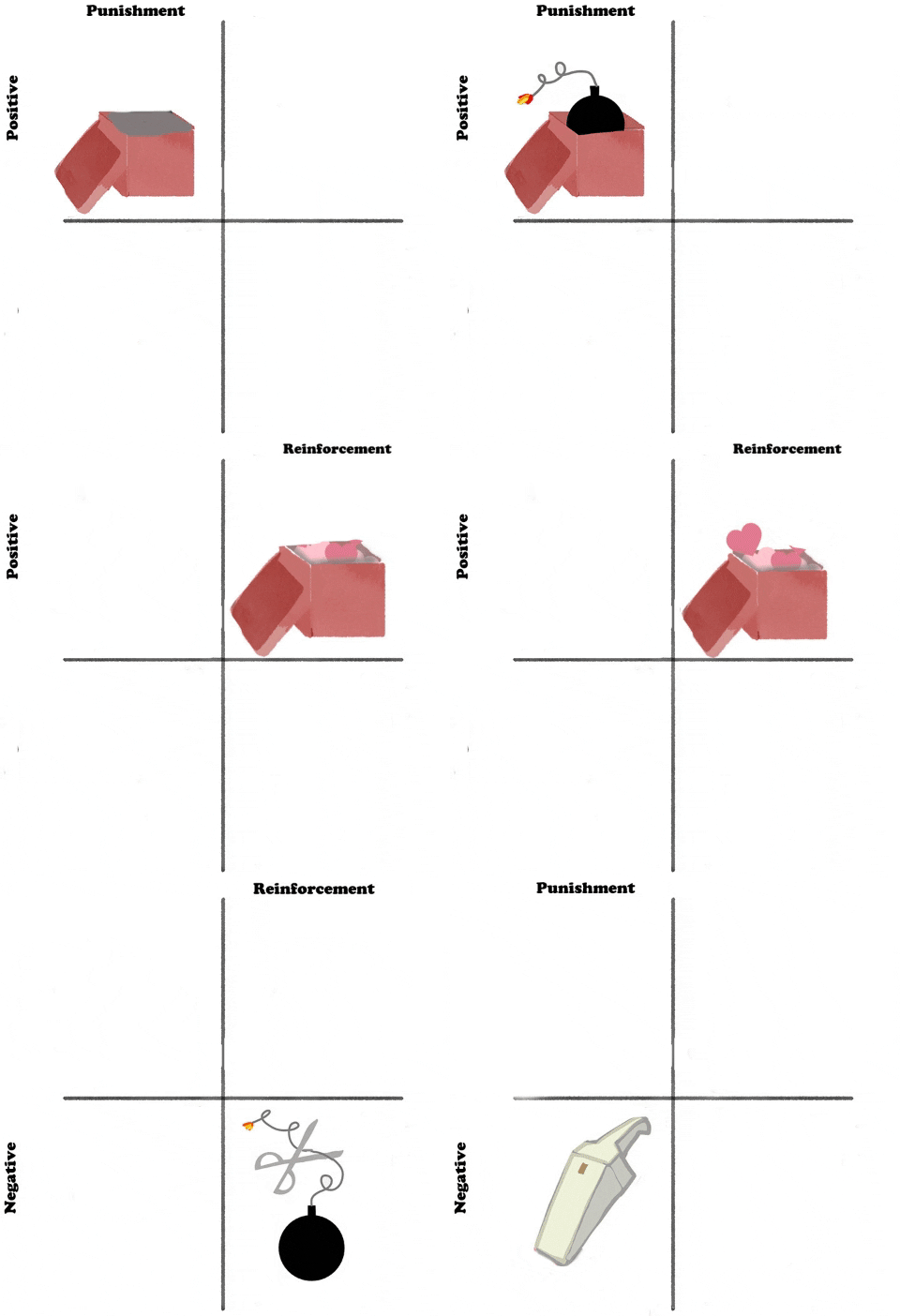
Another nice thing is that it creates a situation where we are the ones controlling the reinforcers. Otherwise, the dog may be reinforced either by the stimuli going away (“I barked at the UPS man left!), or by the cessation of, say, the owner’s yelling and nagging, etc. Technically, these two latter situations are negative reinforcement—negative here is negative as in math, not “negative” as in something bad: The behavior of being quiet is encouraged (that is the reinforcement part) because it subtracts the annoying stuff from the situation (that’s the negative part). Kiki’s method flips the script and makes use of positive reinforcement in that the behavior of barking once is encouraged (aka reinforced) by the addition of a treat (that is the positive part).
Classical conditioning, aka Pavlovian conditioning, comes into play too, which changes the dog’s emotional state. This is basically just learning by association: The dog learns to associate “Thank you!” with getting a treat, which turns his attention from “make that evil mailman man go away with my loud bark” to “Must go to mama for some yum yums!” Eventually, many dogs don’t even need the cue — they learn the pattern: bark once → go to mom. Some even skip the bark entirely and go straight to mom when they hear the trigger. Wouldn’t that be nice.
Like so many aspects of training, this protocol is (to quote Bob Bailey), “simple but not easy.” To get consistent results with this protocol, you can’t really do it half-assed —especially in the beginning. But even when you get into maintenance mode, you have to be pretty on top of it. If you sometimes say “thank you” after one bark but sometimes don’t say “thank you” and sometimes say it after four barks, you may just inadvertently train your dog to bark until you interrupt.
That said, I do a kind of poor-man’s version of this method with my dog, Poppy, and our doorbell. (I live in a two-ish bedroom apartment with a cat, a dog, a newborn and two little girls, so if I do something “half assed,” I feel like it’s usually a quarter better than it could be.) When the doorbell rings, I say “go to your crate!” which is a very strong cue for her. This is because whenever I ask her to go to her crate, there is a 95% percent chance she’s going to get a treat or some other good thing within a minute of her getting there. I don’t really keep track of if she barks once or more than once; the cue is contingent on the doorbell, not her barking. But she tends to not really bark in her crate, and once she is being sent there, she’s pretty focused on getting there and so isn’t barking much. I use “go to crate” because I usually have treats right near her crate that I can give her, or else I have a Treat & Train atop it (my favorite trusty remote-controlled treat dispenser) and, when I have my act together, a button for it by the door so I can trigger it while I buzz someone in. If you’re using rewards in your training, you want them to be easy for the trainer to access and provide to the trainee!
Ideally, the pairing of the doorbell and the “go to crate” cue would lead to her just go to the crate when she hears the doorbell. This happens… sometimes, But I’m not the only person in the house who answers the door, and I usually can’t predict when someone is going to buzz, and I often have one or more children on top of me when someone rings. With dog training, as with parenting, I try to give myself some grace. I mean, the situation is probably than it would be if there were zero dog trainers living with her!
Have a dog training question that you’d like Annie to answer? Submit it here!

(This post contains affiliate links)
Featured image: The Miriam and Ira D. Wallach Division of Art, Prints and Photographs: Picture Collection, The New York Public Library. “He began to bark, so she began to cry,” The New York Public Library Digital Collections. 1919.
Alrighty then! I'm going to try this!
This is really interesting, Annie. I'm curious to see if mine will run back out to bark again and come back for another treat. Would the return prompt another biscuit?